


🧬 AI-Designed DNA Controls Gene Expression in Healthy Mammalian Cells | CRG Breakthrough 2025
By Nataliia Bohdanova
A study published in Cell has achieved a scientific milestone: for the first time, artificial intelligence has designed synthetic DNA molecules that successfully control gene expression in healthy mammalian cells. This breakthrough opens new frontiers in gene therapy, synthetic biology, and precision medicine.
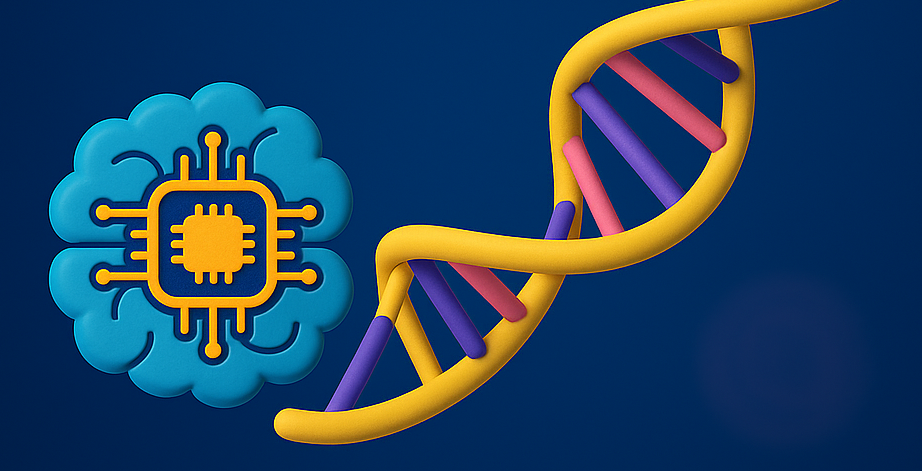
🧠 A New Kind of Biological Software
Researchers at the Centre for Genomic Regulation (CRG) in Barcelona developed an AI tool capable of generating regulatory DNA sequences never seen in nature. The system can be instructed with highly specific goals, like:
| “Activate this gene in stem cells that will become red blood cells, but not in those that will become platelets.”
The AI then calculates the exact sequence of DNA bases (A, T, C, G) to create that expression pattern. Scientists synthesize these ~250-letter-long DNA fragments and deliver them into target cells via viral vectors.
💡 Proof of Concept: It Works
As a test, the AI designed synthetic DNA fragments that would activate a fluorescent gene in some blood cells while leaving other gene activity unchanged. Inserted into mouse cells, the sequences integrated randomly into the genome—and performed exactly as predicted.
| “It’s like writing software for biology,” says Dr. Robert Frömel, lead author of the study. “We now have new ways to instruct cells with unprecedented accuracy.”
🧬 Applications: Targeted, Safer, Smarter
This new ability to control gene expression with precision could revolutionize:
- Gene therapies, by fine-tuning activity only where needed
- Precision medicine, reducing side effects
- Cell programming, by guiding how cells develop and behave
Many diseases arise from cell-type-specific gene regulation errors, for which traditional drugs or protein therapies may never suffice. These AI-designed enhancers offer a powerful alternative.
🌱 Beyond Nature: Inventing New DNA Switches
In natural biology, gene expression is regulated by enhancers—short DNA sequences that switch genes on or off. Until now, scientists were limited to using naturally occurring enhancers shaped by evolution.
AI changes the game. It can now design ultra-specific enhancers that evolution hasn’t yet created—custom switches that control genes exactly as needed in a chosen cell type.
🔬 Building the Biological Language Model
Creating such an AI required vast amounts of biological data. To train the model, the CRG team carried out thousands of lab experiments using blood-forming cell models. They explored the behavior of enhancers and 38 transcription factors—proteins that control gene activity.
Unlike many studies that use cancer cells, this work used healthy cells, making the findings more relevant to real human biology. The team discovered subtle gene regulatory mechanisms shaping immunity and blood production.
📚 A Library of 64,000+ Synthetic Enhancers
Over five years, researchers built the largest synthetic enhancer library ever assembled in blood cells, designing more than 64,000 DNA fragments. They measured how each enhancer functioned during seven stages of blood cell development.
Key discoveries:
- Some enhancers acted like volume knobs, adjusting gene activity up or down
- Others functioned as binary switches—on in one cell type, off in another
- The team observed “negative synergy”, where two activating elements combined to silence a gene instead
These results taught the AI the “grammar” of gene regulation, enabling it to invent new sequences with precise on/off behavior—even if such sequences don’t exist in nature.
🧩 🔍Conclusion: Programming Life
This study marks a shift from reading and editing genomes to writing new genetic instructions from scratch. Using AI, scientists can now design synthetic DNA that programs cells as predictably as software controls computers.
Though still early-stage, this research lays the foundation for:
- Smarter gene therapies
- Fully customized genetic treatments
- Next-gen synthetic biology
With around 1,600 transcription factors in humans and mice, this study is just the beginning. The ability to engineer life at this level could reshape medicine, biotechnology, and our understanding of biology itself.
Under the Windswept Mountain: Vynnykunka – Amid Adventures and Dreams
Meditation, Stress, and Telomerase: Impact on Cellular Aging


