


🦠 Bacteria: Our Tiny Friends and Foes!
🔬 Who first saw bacteria?

A long time ago, in the 1600s, a man named Antonie van Leeuwenhoek looked through a tiny microscope he made himself.
He was the first person to see bacteria!
He called them “animalcules” because they looked like tiny animals swimming around.
Today, we know they are bacteria — tiny living things all around us.
Thanks to Leeuwenhoek, science started to learn about the invisible world! 🦠🔍
🔍 What Are Bacteria?
Bacteria are tiny, tiny living things — so small that you need a microscope to see them!
Each one is made of just one single cell. That’s much smaller than animals, plants, or even the cells in your body.
They’ve been around for billions of years — even before the dinosaurs! 🦕
🌍 Where Can You Find Bacteria?

Everywhere! Bacteria live:
- In soil and water
- In food (like cheese and yogurt)
- On your hands, skin, and teeth
- Inside your stomach and intestines
- Even in volcanoes, ice, and outer space! 🚀
There are more bacteria in your body than human cells!
🧪 What Do Bacteria Look Like?
Bacteria have different shapes:
| Shape | What it looks like |
|---|---|
| Cocci | Little balls |
| Bacilli | Rods or sticks |
| Spirilla | Spirals or squiggles |
| Vibrio | Like tiny commas |

Some bacteria float around alone, and others stick together in groups.
🎨 What Is Gram Staining?
Gram staining is a special coloring trick scientists use to look at bacteria under a microscope.
It helps them tell what kind of bacteria they are looking at.
It’s named after the scientist Hans Christian Gram, who invented it over 100 years ago!

🦠 Why Do We Stain Bacteria?
Bacteria are tiny and almost invisible. So scientists add colorful dyes to make them easier to see.
But Gram staining is not just for color — it tells us how the bacteria are built.
🔵🟣 Two Main Types of Bacteria
After Gram staining, bacteria can look purple or pink:
🟣 Gram-Positive Bacteria
- Stain purple
- Have a thick wall
- Often shaped like balls or rods
- Example: Streptococcus (can cause sore throats)
🔴 Gram-Negative Bacteria
- Stain pink or red
- Have a thin wall and outer layer
- Sometimes more resistant to antibiotics
- Example: E. coli (can live in your gut!)

🧫 How Gram Staining Works (Simple Steps)
- Add purple dye (crystal violet)
- Add iodine (makes the color stick)
- Wash with alcohol
- Add pink dye (safranin)
💡 After all these steps, some bacteria stay purple (Gram-positive), others turn pink (Gram-negative)!
🔍 Why Is It Important?
Doctors and scientists use Gram staining to:
- Learn about bacteria
- Choose the right medicine
- Study how germs behave
- Keep people healthy and safe!
🎉 Fun Fact!
Some bacteria look funny under the microscope — like chains, bunches, or spirals!
Gram staining helps show all their cool shapes too!

🔬✨ Louis Pasteur’s Amazing Discovery
A long time ago, a smart scientist named Louis Pasteur looked at tiny germs through his microscope.
He found something amazing — not all germs are the same!

Some like to breathe air, just like us.
He called them aerobic bacteria — they need oxygen to live.
But others? They don’t need air at all!
They’re called anaerobic bacteria, and they can live in places with no oxygen at all — like sealed jars or deep in the ground!
Pasteur’s discovery helped people understand how food spoils, how fermentation works, and how to stay healthy.
Thanks to him, we learned more about the invisible world of microbes! 🌍🦠💡
😀 Are Bacteria Good or Bad?
Both!
✅ Good Bacteria:
- Help you digest food
- Make vitamins in your belly
- Protect you from bad germs
- Help plants grow
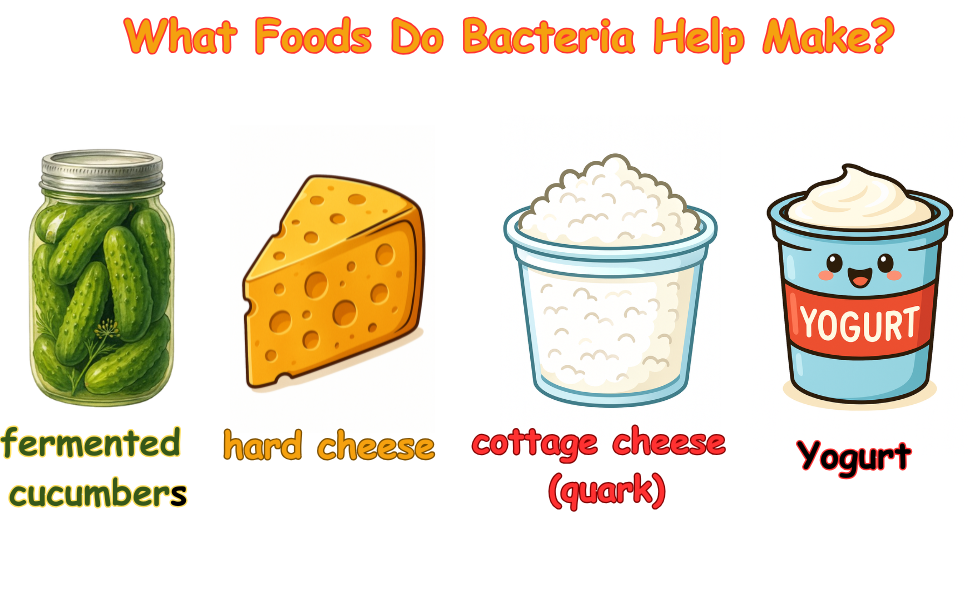
- Make tasty food like yogurt, cheese, and pickles

These good guys live in your gut and are called probiotics!
🎉 Fun Fact!

Scientists taught the bacterium Escherichia coli (E. coli) to produce insulin — a hormone that people with diabetes need to survive.
Thanks to genetic engineering, insulin can now be made in laboratories using these helpful bacteria. This breakthrough has helped millions of people around the world! 💉🧬
❌ Bad Bacteria:
Some bacteria can make you sick.
They cause things like:
- Stomach bugs (🤢)
- Ear infections (👂)
- Sore throats (😷)
- Cavities in teeth (🦷)
That’s why washing hands is so important!
🦠 Common Bacterial Diseases
| 🦠 Disease | 😷 What It Does | 🧬 Bacteria Name |
|---|---|---|
| 🤒 Strep Throat | Sore throat, fever, hard to swallow | Streptococcus pyogenes |
| 🫁 Pneumonia | Trouble breathing, chest pain | Streptococcus pneumoniae |
| 🤢 Food Poisoning | Stomach pain, vomiting | Salmonella, E. coli |
| 🦷 Tooth Decay | Holes in teeth if not brushed | Streptococcus mutans |
| 👅 Diphtheria | Thick coating in throat, trouble breathing | Corynebacterium diphtheriae |
| 🐭 Leptospirosis | Fever, headache, muscle pain (from animals) | Leptospira bacteria |
| 😡 Scarlet Fever | Sore throat, red rash, high fever | Streptococcus pyogenes |
| 🚽 Dysentery | Stomach cramps, diarrhea with blood | Shigella bacteria |
✅ How to Stay Healthy
🧼 Wash your hands
🍽️ Eat clean food
🪥 Brush your teeth
👨⚕️ See a doctor if you feel sick
👇
😬 What Is Botulinum Toxin?
Botulinum toxin is a very strong poison made by a bacterium called Clostridium botulinum.
It can make people very sick if they eat bad food — especially homemade canned meat or dried fish that were not prepared safely.
🧂 Why the Name “Botulinum”?
The word “botulinum” comes from the Latin word botulus, which means “sausage.” 🌭
Long ago, people got sick from eating spoiled sausages, and scientists later discovered this dangerous toxin inside.

So they named it “botulinum toxin” — or “sausage poison”!
🧫 Where Does It Grow?
Clostridium botulinum is an anaerobic bacterium — that means it grows without oxygen! 😮
That’s why it can live in closed jars and sealed cans, where there is no air.
If canned meat or dried fish isn’t cooked or stored properly, the bacteria can grow and make poison inside. 😱
😷 Why Is It Dangerous?
Botulinum toxin is one of the most powerful poisons in the world. Even a tiny amount can cause:
- Muscle weakness
- Trouble seeing
- Difficulty breathing
It can be life-threatening if not treated quickly.
✅ How Can We Stay Safe?
- Don’t eat bulging cans
- Always cook and store food properly
- If something smells bad or looks weird — don’t eat it!
- Keep homemade canned foods in a cool place.
🎯 Fun Fact!
Doctors use tiny amounts of botulinum toxin to help treat muscle problems — and sometimes even to smooth wrinkles!
🧬 How Do Bacteria Grow?
Bacteria grow by doing something called binary fission — that means one cell splits into two.
Then two become four… and soon there are millions!

That’s why food spoils quickly or infections spread fast if we don’t keep things clean.
🔄 How Bacteria Share Secrets!
Bacteria are tiny, but they’re smart! 🧠
They can share special information with each other.
This process is called conjugation (say: kon-joo-GAY-shun).
🧬 What Do They Share?
They pass little rings of DNA called plasmids — like giving each other tiny instruction books.
Plasmids can help bacteria:
- Become stronger 💪
- Resist antibiotics 🛡️
- Learn new tricks!

🤝 How Does It Happen?
- One bacterium grows a tiny bridge called a pilus
- It connects to another bacterium 🤝
- The plasmid slides across the bridge to the new friend
- Now they both have the same special DNA!
🦠 Why Is It Cool?
Bacteria don’t need to wait to grow up to change.
They can share information fast — like texting with DNA!
It’s one way bacteria adapt and survive in tough places.
🛡️ How to Stay Safe from Bad Bacteria
- 🧼 Wash your hands with soap and warm water
- 🍎 Wash fruits and vegetables before eating
- 🦷 Brush your teeth every day
- 🧴 Use hand sanitizer when there’s no sink
- 💊 Take medicine only from your doctor

🎉 Fun Bacteria Facts!
- There are trillions of bacteria in your body
- Some bacteria can glow in the dark 🌟
- Bacteria helped scientists invent antibiotics like penicillin
- Some bacteria live in deep oceans where no light ever shines!
📚 In Summary
Bacteria are tiny but powerful. Most are helpful and important for life.
A few can cause illness — so learning about them helps us stay healthy, smart, and safe!


