Plants create their own food through photosynthesis. Chlorophyll is essential for photosynthesis as it absorbs light energy from the sun. Leaves are the main organ responsible for photosynthesis. The leaves capture the energy from sunlight and use it to make simple sugars like glucose and sucrose from carbon dioxide and water. They store sugars as starch.
Parts of leaves
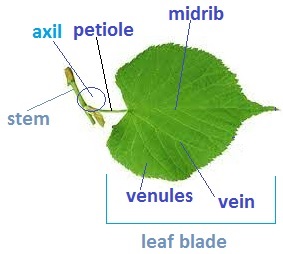
Leaf contains three parts: leaf base, petiole, and lamina.
Leaf base: It is the basal part of the leaf by which the leaf gets attached to the stem.
- In monocotyledons, the leaf base expands into a sheath covering the stem partially or wholly.
- Stipule: In many species of plants the leaf may bear two lateral small leaf-like structures called stipules.
Petiole
It is a stalk-like structure in leaves. The petioles are Long thin and flexible that allowing leaf blades to flutter in wind, thereby cooling the leaf and bringing fresh air to the leaf surface.
Lamina
It is also called the leaf blade. it is the green expanded part of the leaf having veins and veinlets.
There is, usually, a middle prominent vein, which is known as the midrib.
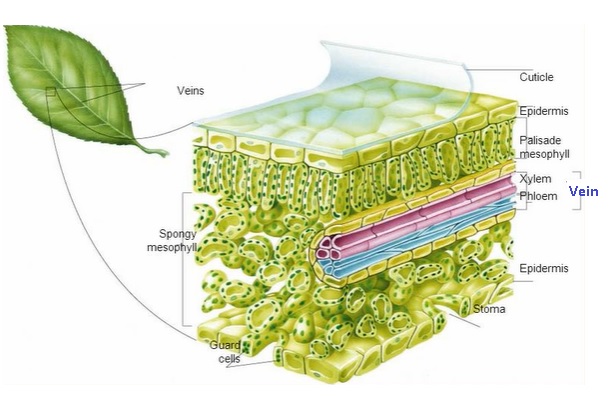
Veins provide rigidity to the leaf blade and act as channels of transport for water, minerals, and food materials. The shape, margin, apex, surface, and extent of incision of lamina vary in different leaves.
Venation in leaves
Venation can be defined as the location of veins and veins in the lamina of the leaf. Different types of plants have different types of venation.
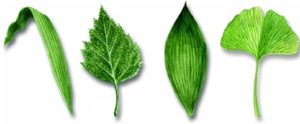
Reticulated venation. When the veins form a network, the venation is called reticular. The leaves of dicotyledonous plants usually have reticulated venation.
Parallel venation. When the veins run parallel to each other within the lamina, the venation is called parallel. Parallel venation is characteristic of most monocotyledonous plants.
Arcuate venation. When leaves in which large veins, in addition to the central one, are curved like an arc.
Internal structure of the leaf
Types of leaves
Leaves are divided into two main categories: simple and complex leaves, and are also divided into different groups depending on their structure, shape, size.
Simple leaf: it is said that a leaf is simple, if its plate is intact or incised, the incisions do not touch the midrib. former. Guava
Compound leaf: when the cuts of the plate reach the midvein, breaking it into several leaves and connected by one petiole, the leaf is called compound.
The compound leaves are further divided into types:
Pinnately compound leaf: A number of leaflets are present on a common axis, the rachis, which represents the midrib of the leaf as in neem. Pinnately compound leaves are divided into the following groups:
- Paripinnate: the leaf is without a terminal leafle.
- Unparipinnate: pinnate leaf with apical leaf.
Palmately compound leaf: In this type of compound leaves, the leaflets are attached at a common point, i.e. at the tip of the petiole.
Trifoliate: The leaves consist of three leaflets that are emerging from the same point.

Phyllotaxy
The temper of arrangement of leaves on the stem or branch is called the Phyllotaxy. These are of three types:
Alternate: In this type of phyllotaxy, a single leaf arises at each node in an alternate manner, for example, in mustard, and sunflower plants.
Opposite: In the opposite type, a pair of leaves arise at each node which lies opposite to each other. Calotropis and guava plants.
Whorled: when more than two leaves arise at a node that forms a whorl of leaves, called whorled phyllotaxy. Alstonia.
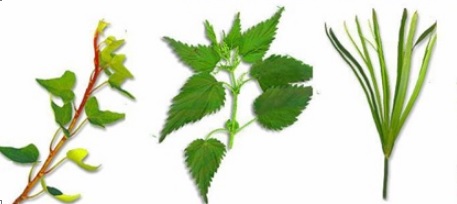
Alternate, opposite, whorled
Modification of leaves
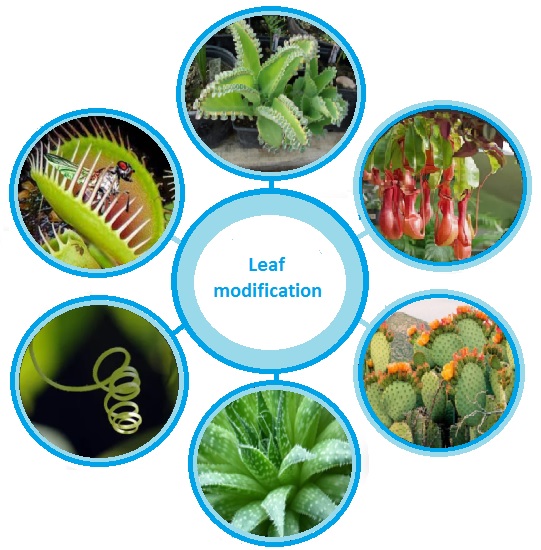
Whole leaf tendril – in this type entire leaf is modified into a tendril. Wild pea.
Petiolar tendril – petiole modified into a tendril Nepenthes. Spine – the whole leaf or part of the leaf modifies in the form of spines. Functions for protection, transpiration, Opuntia.Reproductive – adventitious buds. Bryophyllum.
Insect catching – the leaves modify to catch insects and absorb their Nitrogen for plants’ requirements.
Succulent – the leaves become fleshy due to storage of food material or water.