Classification:
- Class Cycadophyta (Cycads)
- Class Gnetophyta (Gnetophytes)
- Class Pinophyta (Conifers)
- Class Ginkgophyta (Ginkgoes)
General Characteristics of Gymnosperms
Features of Gymnosperms
- A group of seed plants with approximately 700 species.
- Unlike ferns, they reproduce through seeds rather than spores.
- Their ovules and seeds are exposed, not enclosed in a fruit, which distinguishes them from angiosperms.
- They lack carpels, ovaries, and true fruits.
- They are trees or shrubs, some reaching enormous sizes.
- Well-developed branching system:
- Some species have small, scale-like leaves,
- Others have large, feathery leaves.
- Most species lack vessels in the xylem and companion cells in the phloem, but their tissues are more complex than those of ferns.
Structure of Gymnosperms
- An ancient yet thriving group of plants bridging the evolutionary gap between ferns and flowering plants.
- Previously, all seed plants without flowers were classified within Spermatophyta, but modern botanists now consider them separate taxa.
- Vegetative organs:
- Leaves – needle-like or scale-like, evergreen in most species.
- Stems and wood – lack vessels, slowing water transport and reducing moisture loss.
- Resin production – protects against damage and infections.
- Adapted to various environmental conditions, including arid and cold regions.
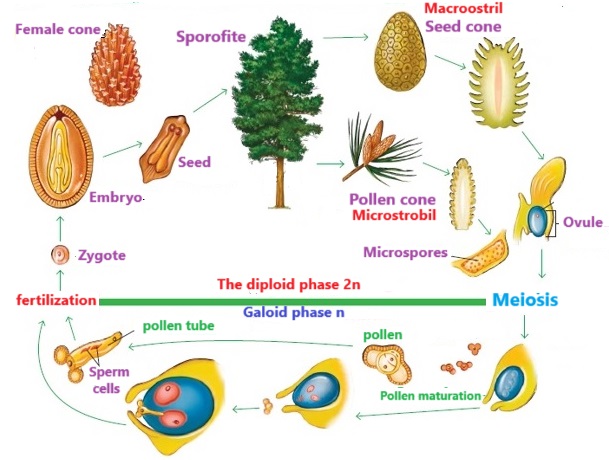
Reproduction of Pine Trees (Pinus)
Pine trees, like other conifers, reproduce through seeds contained in cones. Their reproductive cycle is long and complex, often taking up to two years from pollination to seed dispersal.
Male Cones (Microstrobili)
- Small, yellow, clustered together on branches.
- Each cone consists of a central axis with numerous scales (microsporophylls).
- On the underside of each scale, two pollen sacs (microsporangia) develop, producing pollen grains.
- Pollen grains have two air sacs, allowing them to be easily carried by the wind over long distances (sometimes hundreds of meters).
Female Cones (Megastrobili)
- Consist of a central axis with woody scales.
- Each scale has two ovules (seed precursors) on its upper side, facing the cone’s base.
- When pollen lands on a young female cone, fertilization does not occur immediately—it takes over a year.
Pine Tree Reproductive Cycle
- First Summer
- Female cones appear reddish, about 5 mm long.
- Ovules have not yet developed egg cells or endosperm.
- Pollination occurs as wind-blown pollen grains land on receptive female cones.
- Second Summer
- Female cones grow to 3–4 cm in length and turn green.
- Inside the ovules, endosperm and egg cells form.
- Fertilization occurs, about a year after pollination.
- Following Winter
- Fertilized ovules develop into seeds.
- Female cones mature, turn brown, and reach 5–6 cm in length.
- By late winter or early spring, mature seeds with thin, wing-like structures are dispersed by the wind.
Unique Feature
A single pine tree can bear female cones of different ages simultaneously, meaning cones from different reproductive stages can be observed on the same tree.
Evolution and Fossil Record
- Gymnosperms first appeared in the Late Devonian period.
- By the Carboniferous and Permian periods, their major orders had already evolved.
- The Mesozoic Era was the peak of gymnosperm diversity and dominance in global ecosystems.
- Seed ferns (Pteridospermophyta) – an extinct group of plants resembling ferns but reproducing through seeds.

Structure and Ecology of Pine and Spruce
Pine (Pinus)
- Growth Form: A tall, slender tree. In dense forests, the first branches are at least 10 meters above ground, while in open areas, the trunk is shorter and thicker.
- Branching Pattern: The largest branches grow in whorls, which can be used to roughly estimate the tree’s age.
- Needles: Grow in pairs on shortened shoots, covered with a thick epidermis. Stomata are located in deep grooves to reduce water loss.
- Vascular System: Pine needles contain only two vascular bundles, which do not branch.
- Adaptations: The thick epidermis, absence of true vessels, and reduced surface area help conserve moisture, making pines highly drought-resistant.
Spruce (Picea)
- Growth Form: A tall tree with a narrow, conical crown.
- Needles: Short, stiff, pointed, and arranged in a spiral around the twig. They stay attached for 6-8 years (up to 15 years in mountainous regions).
- Branching Pattern: Spruce branches droop downward, giving the tree its characteristic shape.
Ecological and Biological Differences Between Pine and Spruce
| Feature | Pine (Pinus) | Spruce (Picea) |
|---|---|---|
| Light Requirement | Sun-loving, cannot grow in shade | Shade-tolerant, grows under pine cover |
| Needle Lifespan | 2-3 years | 6-8 years (up to 15 in mountains) |
| Soil Preference | Can grow on poor soils, sand, rocks, and bogs | Prefers nutrient-rich soils |
| Fire Resistance | Thick bark, can survive mild fires | Thin bark, vulnerable to fire |
| Root System | Taproot, deep in normal soils; shallow in bogs | Shallow roots, making it less stable in storms |
Competitive Interactions
Pine and spruce compete for dominance in forests:
- Pine is more drought-tolerant and fire-resistant, making it better suited for dry or sandy soils.
- Spruce thrives in rich, moist soils and shaded environments, often growing beneath pines before eventually replacing them.
- Their different adaptations create a complex ecological balance, with each species dominating under specific conditions.
Diversity of Conifers: Focus on Pines (Pinus Genus)
Pines make up approximately one-third of all conifer species.
- All pines have shortened shoots (fascicles) with clusters of needles.
- Needle clusters vary:
- 2 needles per cluster (e.g., Scots pine Pinus sylvestris)
- 3 needles per cluster (e.g., Ponderosa pine Pinus ponderosa)
- 5 needles per cluster (e.g., Eastern white pine Pinus strobus, or “cedar pines,” which produce edible “pine nuts”).
- Pines also vary by:
- Needle length – some species have needles up to 30 cm long.
- Cone size and weight – some species produce cones weighing up to 2 kg.
Other Important Conifer Genera
- Fir (Abies)
- Grows naturally in North America, Europe, and Asia.
- Similar in appearance to spruce but has flat needles instead of triangular ones.
- Upright cones (unlike spruce, where cones hang downward).