LESSON 1. The Tissue Level of Organization
Aligned with introductory U.S. high school and college Anatomy & Physiology (A&P) courses.
🔬What Is a Tissue?
A tissue is a group of cells and their surrounding extracellular material organized to perform one or more specific functions.
The scientific study of tissues is called histology.
🧩 Levels of Organization in the Human Body
Cells → Tissues → Organs → Organ Systems → Organism
For example:
- 🧫 Cell: Cardiac muscle cell (cardiomyocyte)
- ❤️ Tissue: Cardiac muscle tissue
- 🫀 Organ: Heart
- 🩸 Organ system: Cardiovascular system
🧪The Four Primary Types of Human Tissues
The human body contains four fundamental tissue types.
| Tissue type | Main function |
|---|---|
| 🛡️ Epithelial | Protection, absorption, secretion, filtration |
| 🦴 Connective | Support, binding, protection, transport |
| 💪 Muscle | Contraction and movement |
| 🧠 Nervous | Communication, coordination, control |
Each tissue has a specialized structure that enables it to perform its functions.
Key principle: Structure determines function.
🛡️ 1. Epithelial Tissue
Epithelial tissue (epithelium) covers body surfaces, lines internal organs and cavities, and forms glands.
🔍 Main Characteristics
- Closely packed cells: Very little extracellular matrix separates the cells.
- Polarity: Cells have an apical (free) surface and a basal surface.
- Basement membrane: Anchors the epithelium to underlying connective tissue.
- Avascularity: Epithelial tissue contains no blood vessels; nutrients reach it by diffusion.
- Regeneration: Many epithelial tissues can replace damaged cells rapidly.
🧱 Classification by Cell Shape
🔬 Classification of Epithelial Tissue by Cell Shape
Epithelial cells are classified into three main types based on their shape: squamous, cuboidal, and columnar.
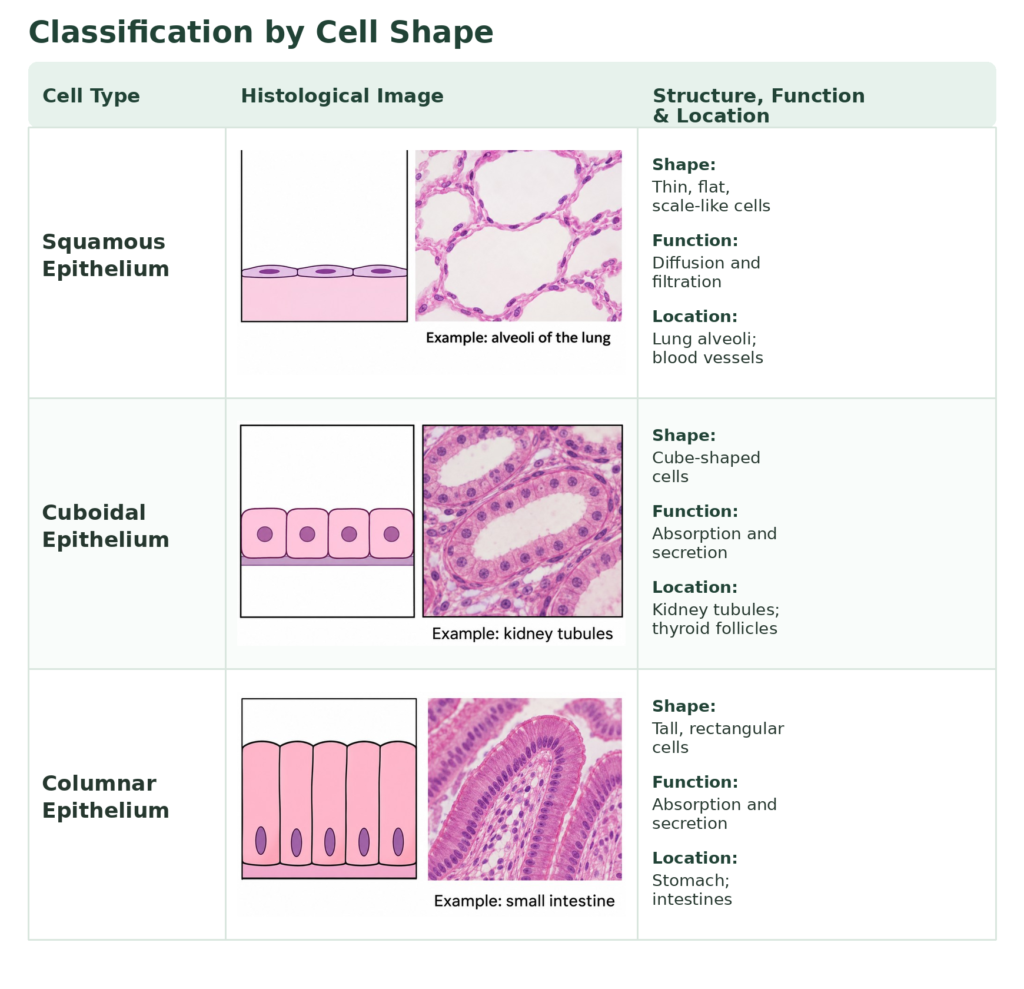
💡 Remember: Squamous = flat, Cuboidal = cube-shaped, Columnar = tall.
Note: This table shows examples of simple epithelium. Epithelial tissues are also classified by the number of cell layers.
📚 Classification by Number of Layers
| Type | Structure | Example |
|---|---|---|
| Simple | One cell layer | Lung alveoli |
| Stratified | Multiple layers | Epidermis |
| Pseudostratified | One layer that looks multilayered | Trachea |
| Transitional | Specialized layers that accommodate stretching | Urinary bladder |
🔗 Cell Junctions
- 🔒 Tight junctions: Restrict movement of substances between neighboring cells.
- 🧷 Desmosomes: Provide strong mechanical connections between cells.
- 🔄 Gap junctions: Allow ions and small molecules to pass directly between cells.